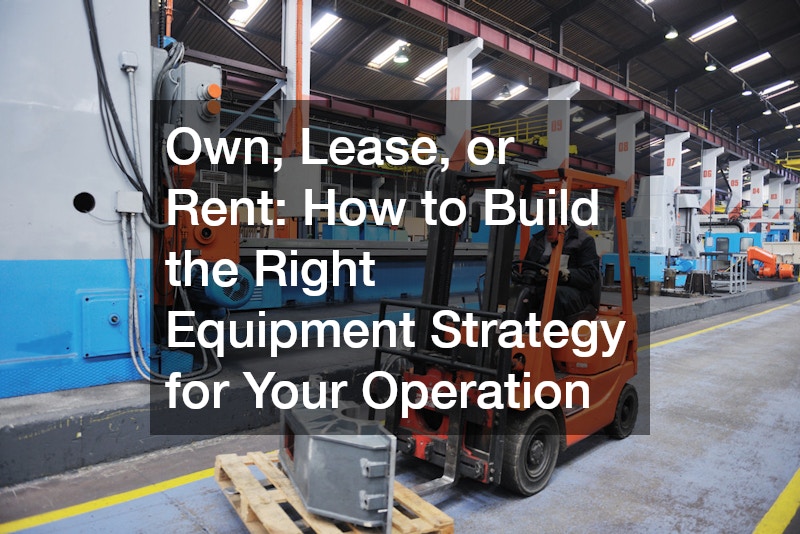
Understanding how to acquire and manage equipment is one of the most consequential decisions an operations leader can make. The choice between owning, leasing, and renting affects cash flow, operational flexibility, maintenance burden, tax exposure, and long-term competitiveness. There is no single right answer — the best strategy depends on your industry, your growth trajectory, your capital position, and how predictable your equipment needs are from one quarter to the next. What follows is a practical framework for thinking through each option clearly.
Should You Own Your Equipment?
The Benefits of Ownership
Ownership makes the most sense when equipment is central to your core operation, used consistently at high capacity, and unlikely to become obsolete in the near term. When you own an asset outright, you eliminate recurring payments, build equity, and retain complete control over how the equipment is used, maintained, and modified.
For operations with stable, predictable demand and the capital to purchase without straining liquidity, ownership can deliver the lowest total cost over the life of the asset.
Considerations for Maintenance and Depreciation
The hidden costs of ownership are where many operations get caught off guard. Maintenance, repairs, insurance, storage, and eventual disposal all fall entirely on the owner, and these costs can be substantial, particularly as equipment ages. Depreciation is another factor that demands honest accounting. The moment a piece of equipment enters service, its value begins to decline, and that decline accelerates with age and wear. Operations that carry aging fleets on their books at inflated values can find themselves in a difficult position when replacement becomes necessary, and the residual value of the old equipment does not offset the cost of the new.
Financial Implications
On the positive side, equipment ownership comes with meaningful tax advantages. Section 179 of the IRS tax code allows businesses to deduct the full purchase price of qualifying equipment in the year it is placed in service, rather than depreciating it over several years. Bonus depreciation provisions can further accelerate these deductions. For profitable operations with strong cash positions, these benefits can make an outright purchase a genuinely attractive option.
Is Leasing Equipment a Better Option?
The Advantages of Leasing
Leasing appeals to operations that want to preserve capital, maintain access to current equipment without the commitment of ownership, and keep monthly costs predictable. Because leases typically require little or no down payment and spread costs over time, they free up cash that can be deployed elsewhere in the business. For equipment categories where technology evolves quickly — and where being locked into an aging asset carries real operational risk — leasing provides a natural upgrade path at the end of each term.
Understanding Lease Agreements
Lease agreements vary significantly in their structure, and the details matter enormously. Operating leases and capital leases carry different accounting treatments, different end-of-term obligations, and different implications for your balance sheet. Before signing any lease agreement, scrutinize the terms around mileage or usage caps, maintenance responsibilities, early termination penalties, and what happens at the end of the lease period. Hidden fees embedded in complex lease language have a way of surfacing at the worst possible moment — typically when you are trying to exit an agreement or transition to new equipment.
When Is Renting Equipment the Right Choice?
The Situational Benefits of Renting
Renting is the most flexible of the three options, and flexibility is its defining value. When demand spikes unexpectedly, when a project requires specialized equipment that would otherwise sit idle, or when a facility transition creates a temporary gap in capacity, renting allows operations to respond quickly without making long-term financial commitments. Cold chain operations, for example, frequently turn to refrigerator trailer rentals — and in some cases explore refrigerator trailer sales as a middle-ground option — when production surges, equipment fails, or a warehouse renovation temporarily reduces on-site cold storage capacity. The ability to scale up and scale back down without carrying the cost of idle assets is a significant operational advantage.
Short-Term vs. Long-Term Rentals
Not all rentals are created equal, and the cost structure changes considerably depending on duration. Short-term rentals — days or weeks — carry a higher daily rate but offer maximum flexibility and minimal commitment. Long-term rentals — months or more — typically come with discounted rates and can approach the economics of leasing, particularly when maintenance is included in the rental agreement. The break-even point between renting and leasing varies by equipment type and provider, so running the numbers on both options before committing to a long-term rental is always worthwhile.
The most effective equipment strategies are rarely built around a single approach. Most well-run operations maintain a core fleet of owned or leased assets calibrated to their baseline demand, supplemented by rental relationships that can be activated when volume, circumstance, or opportunity requires it. Own what you always need, lease what you need reliably but want flexibility on, and rent what you need occasionally or unpredictably. Applied consistently, this framework keeps capital working efficiently, preserves operational agility, and ensures that your equipment strategy is always an asset to your operation rather than a constraint on it.